How Homebuilders Keep 300 Floor Plans From Drifting
Share this article


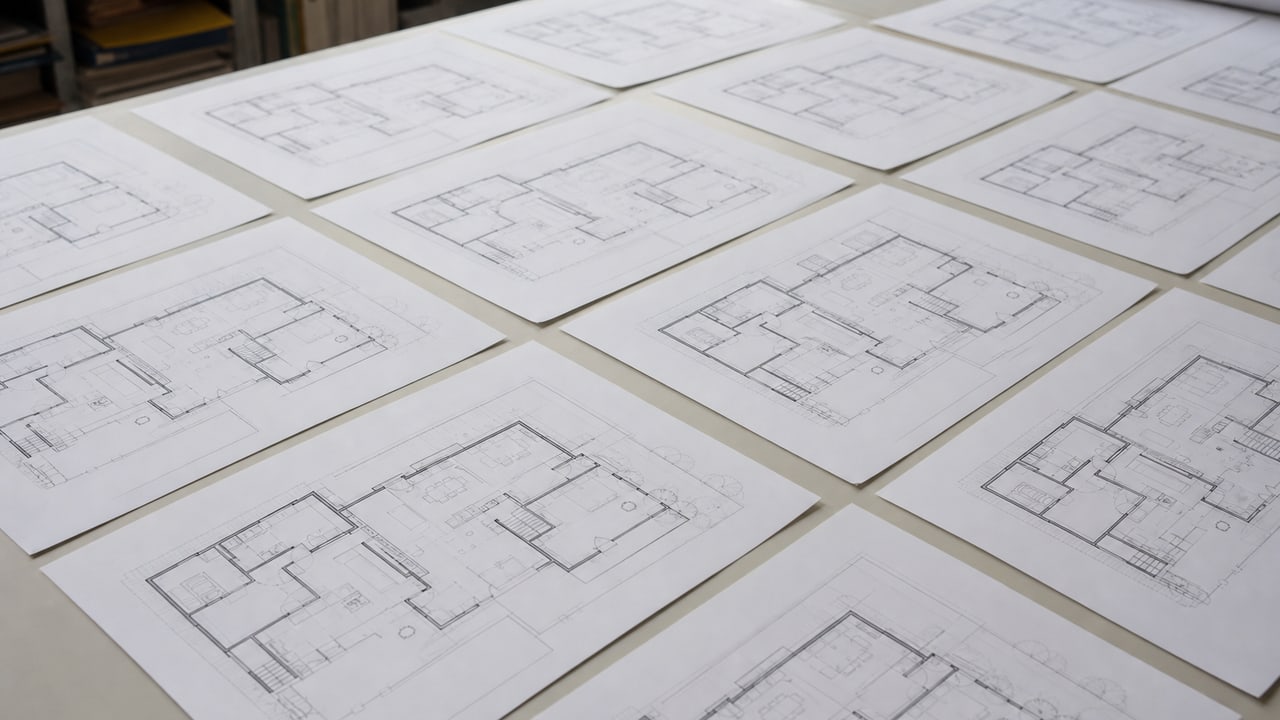
A step-by-step guide to choosing an outsourced floor plan drafting partner built for production, how homebuilders vet for volume, consistency, and turnaround.
Repetitive Floor Plans, Zero Drift: Choosing a Drafting Partner Built for Production
To choose an outsourced floor plan drafting partner built for production, vet in this order: proven volume experience, a template-and-standards system that prevents drift, batch quality control, predictable turnaround, capacity that flexes with your starts, and same time-zone communication. The goal isn't one clean set, it's the same clean set replicated across hundreds of plans without quality drifting between them.
Outsourcing a single custom floor plan is easy. Keeping 300 near-identical plans consistent is the real problem, and it needs a partner built for it. This guide walks the vetting step by step.
Why Production Drafting Is a Different Purchase
A one-off drafting gig is judged on a single deliverable. Production drafting is judged on consistency across many, and that changes everything about who you should hire. The U.S. started roughly 1.36 million housing units in 2025, single-family being the largest homebuilding segment (U.S. Census Bureau), and production builders push the same plan types through drafting again and again.
At that volume, the failure mode isn't a bad drawing, it's drift: subtle inconsistencies that creep in between "identical" plans until the field, the trades, and the inspectors start finding differences that shouldn't exist. A partner built for production stops drift by design. A freelancer built for one-offs can't. This guide is intermediate difficulty and takes about an afternoon to run against two or three candidates.
Before You Start: What to Have Ready
- Two or three of your standard plan types (redacted) to use as a live test.
- Your CAD/BIM templates, layer standards, and title-block conventions.
- A sample of a plan variation (same base, different option or site) to test consistency.
- Your typical monthly volume and peak-season volume.
- Your required turnaround per standard set.
Time to a confident decision: an afternoon. Onboarding a chosen partner can run as fast as 72 hours.
Step 1: Verify Real Production Volume Experience
By the end of this step you'll know whether the partner has drafted at scale or only one-off sets. Ask for examples of repeated-plan work, subdivisions, plan catalogs, option packages, not just individual custom homes.
Volume experience shows up in how they talk about the work. A production-ready partner describes systems: template libraries, naming conventions, version control across plan variants. A one-off drafter describes each project as unique. The difference predicts whether they'll hold together at your volume.
Verify it worked: they can describe how they managed consistency across a past multi-plan project.
Step 2: Inspect the Template and Standards System
By the end of this step you'll know how they prevent drift. The single biggest driver of consistency at scale is a locked template-and-standards system, shared title blocks, layer standards, and reusable detail libraries that every plan inherits.
Ask to see it. A partner who works from a maintained standards library will produce plan #300 the same way as plan #1. A partner who redraws conventions each time will introduce variation you'll pay for in the field. Where you have your own standards, confirm they'll adopt yours rather than impose theirs.
Verify it worked: they can show or describe a standards library and how it's enforced across drafters.
Step 3: Test Batch Quality Control
By the end of this step you'll know their QA scales. One-off QA checks a single set; production QA checks for consistency across a batch and catches systematic errors before they replicate.
Ask how they'd review 40 versions of the same plan. The right answer describes a checklist and a cross-set comparison step, not just "we check each one." A systematic error caught in QA is a non-event; the same error shipped across 40 homes is a callback campaign.
Verify it worked: they describe a batch-level QA process, not only per-sheet review.
Step 4: Run a Paid Consistency Test
By the end of this step you'll have proof, not promises. Give a small paid test: a base plan plus a variation, drafted to your templates. Then check three things, accuracy, adherence to your standards, and whether the base and the variation are consistent with each other where they should be.
The variation is the real test. Anyone can draft one clean plan; the production question is whether the second, related plan stays true to the first. How they handle a correction matters too, a production partner fixes the root cause across the set, not just the one sheet you flagged.
Verify it worked: the test set is accurate, on-standard, and internally consistent, and revisions close cleanly.
Step 5: Confirm Turnaround You Can Schedule Around
By the end of this step you'll know if their cadence fits your pipeline. Production building runs on sequenced dependencies, so you need a partner who commits to a consistent turnaround per set and holds it during busy periods.
Ask for typical turnaround on a standard plan and what happens when volume spikes. Predictability matters more than raw speed here, a reliable three-day cadence you can plan around beats an unpredictable one that's sometimes faster.
Verify it worked: you get a committed turnaround figure and a clear answer on peak-season capacity.
Step 6: Match Capacity and Time Zone to Your Build
By the end of this step you'll know they can scale with you and communicate in real time. Confirm they can add drafters when your starts ramp and scale back when they slow, so you're not carrying idle cost in a soft quarter.
Then confirm time-zone overlap. Nearshore partners work U.S. hours, so a redline on a plan variant gets resolved the same day instead of waiting overnight, which, across hundreds of plans, is the difference between a smooth pipeline and a backlog.
Verify it worked: they confirm flex capacity and real overlap with your core hours in writing.
The Mistakes That Let Drift Creep In
Hiring a one-off drafter for production work. The freelancer who nailed your custom home may have no system for keeping 300 plans consistent. Vet for volume experience, not just a nice portfolio.
Skipping the variation test. A single clean sample proves nothing about consistency. Always test a base plan plus a related variation together, drift shows up in the relationship between sets, not in one set alone.
Accepting per-sheet QA as production QA. If their quality process can't catch a systematic error across a batch, that error will ship across every home that used it. Insist on batch-level review.
Ignoring turnaround predictability. Chasing the fastest quote instead of the most consistent cadence backs up your permit and construction schedule the first time volume spikes.
What Success Looks Like
Done right, you have a drafting partner producing your repeated plans on a predictable cadence, to your standards, with plan #300 as clean and consistent as plan #1, at roughly 50% of in-house drafting cost, with capacity that flexes to your starts. WorldTeams places nearshore drafters screened from the top 3% of applicants, working your hours, and supports production builders including Toll Brothers.
The measurable signals: field callbacks tied to drawing inconsistencies trend toward zero, your permit pipeline stops stalling on drafting, and your internal team reviews for design intent instead of fixing conventions.
The Difference Between a Drafter and a Production Line
Any capable drafter can hand you one clean floor plan. Keeping hundreds of them consistent, plan #300 matching plan #1, is a production capability, and it's what you're really buying.
Vet for systems, test with a variation, and choose the partner whose cadence you can build a schedule around.
If you'd rather start with a partner already running production drafting for homebuilders, that's the part we handle.
- floor plan drafting
- homebuilders
- production at scale
Frequently asked questions
Where can homebuilders outsource repetitive floor plan drafting at scale?
Through nearshore AEC-specialized partners with production-drafting systems, template libraries, batch QA, and flex capacity, rather than freelance marketplaces built for one-off gigs. For builders, the deciding factors are consistency across repeated plans and the ability to scale with your starts while working your time zone.
How is production floor plan drafting different from a one-off?
A one-off is judged on a single deliverable; production is judged on consistency across many near-identical plans. That shifts the vetting from portfolio quality to systems, templates, standards enforcement, and batch QA, because the failure mode at scale is drift between plans, not a single bad drawing.
How do I keep quality consistent across hundreds of plans?
Insist on a locked template-and-standards system plus batch-level quality control, and test it with a base-plus-variation sample. Consistency is a process, not a talent trait, the partners who hold it at 300 plans are the ones with a maintained standards library and cross-set QA, not the fastest individual drafter.
How much can outsourcing production drafting save?
Around 50% versus in-house drafting cost, before the overhead you avoid on recruiting and idle capacity in slow periods. The larger saving for production builders is often indirect: fewer field callbacks from inconsistent plans and a permit pipeline that stops stalling on drafting turnaround.