Remote Architecture Staffing That Knows US Code
Share this article


What Remote Architecture Staffing Actually Means for a US Firm
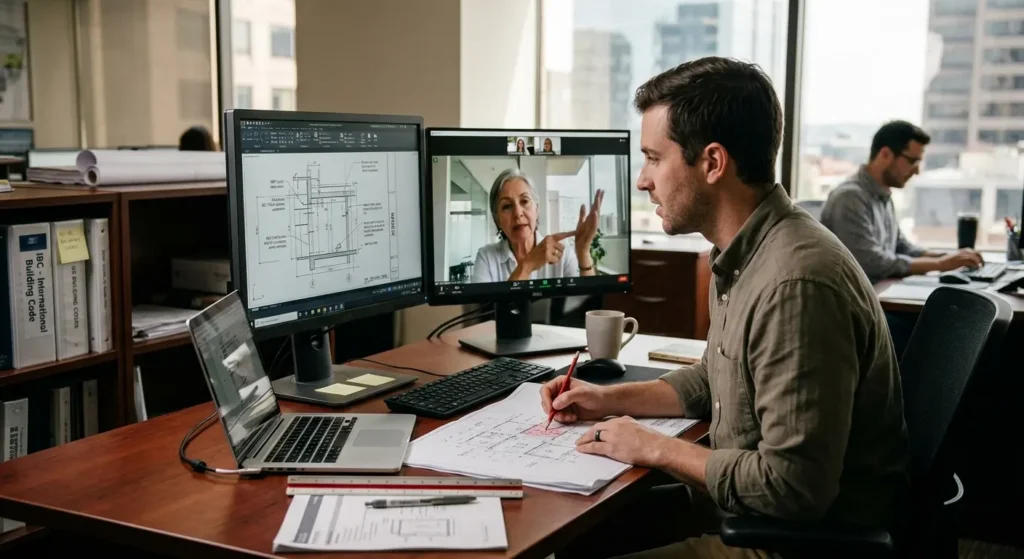
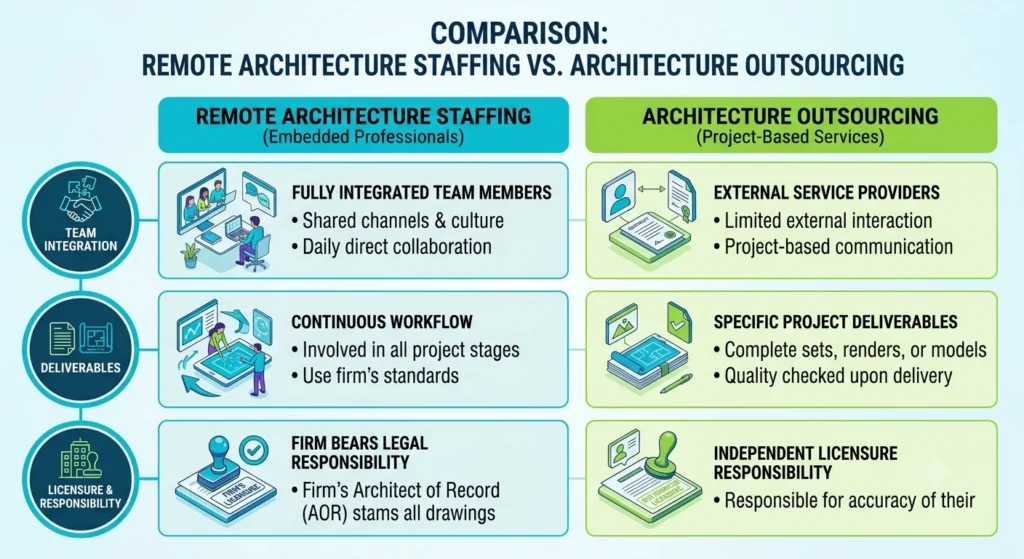
Remote architecture staffing is a hiring model where a US firm adds architectural professionals — drafters, BIM modelers, designers, renderers, project coordinators — who work as embedded members of the firm’s own team from another country, under the direction of the firm’s licensed architects. A staffing partner handles sourcing, vetting, contracting and payroll. The firm keeps the work, the software, the standards and the seal.
The distinction that matters: architecture staffing gives you people, outsourcing gives you deliverables. With staffing, a drafter shows up in your Revit model, your Slack channel and your Monday morning coordination call. With outsourcing, you send a redline package out and a set comes back. Both are legitimate, and our architecture outsourcing services sit on the other side of that line. They fail for completely different reasons, and most firms that get burned picked the wrong one for the problem they had.
Here is what the model includes in practice:
– Full-time or part-time professionals working your hours, not a shifted overnight schedule
– Direct integration into your BIM environment, file naming standards and QA workflow
– The staffing partner absorbing recruiting, background checks, payroll, benefits and local employment compliance
– No licensure transfer — your architect of record still stamps the drawings
– Contract terms measured in months, not multi-year employment commitments
The common misconception is that remote architecture staffing is a cheaper version of hiring a local employee. It is not the same product. You are trading a small amount of physical proximity for a much larger amount of financial flexibility and a wider talent pool. Firms that understand that trade get value out of it. Firms that expect an identical experience at half the price get frustrated in month two.
The model matured fast. A decade ago, remote architectural production meant emailing DWGs to a vendor in a distant time zone and hoping. Cloud-hosted BIM changed the physics of it. When the model lives in Autodesk Construction Cloud and everyone works in the same live file, the question stopped being “can they access the work” and became “do they understand the work.”
Why US Architecture Firms Are Rethinking How They Add Capacity
The core pressure is a mismatch between incoming interest and billable certainty. In June 2026, the AIA/Deltek Architecture Billings Index marked 41 months without a majority of firms reporting billings growth — one of the longest downturns in the index’s 30-plus year history. In the same month, the project inquiries index sat at 56.1, comfortably above the 50 line.
Read those two numbers together and you get the defining problem of the current market. Interest is there. Signed, billable, predictable work is not. Firms are being asked to quote, plan and produce more while having less confidence about what closes.
Permanent headcount is the worst possible instrument for that situation, and that gap is exactly what remote architecture staffing exists to cover. And the cost side confirms it. The AIA 2025 Firm Survey puts personnel costs — salaries, benefits and owner compensation — at an average of 49% of net revenue for firms billing $1 million to $3 million a year. Top-quartile firms by operating profit hold that number between 44% and 47%. Bottom-quartile firms run 54% to 60%. The line between a healthy margin and a squeezed one sits around 48%.
So a single hire in the wrong quarter can move a firm across that line. Meanwhile 49% of firm leaders surveyed by AIA rated retaining current staff and meeting salary expectations as a major concern for 2026, and AIA’s chief economist has repeatedly named labor shortages as a drag on both construction and architect billings.
The talent pipeline offers no relief. BLS projects essentially no employment growth for drafters through 2035, with roughly 14,400 openings a year driven almost entirely by retirements and career changes. Median drafter pay was $68,090 in May 2025. Median architect pay was $99,280. Neither number includes the load that benefits, taxes, software seats and desk space add on top.
The firms that ignore this end up in a familiar loop: turn down work because production is full, hire in a hurry when a large project lands, then carry that salary through the next soft quarter. Two cycles of that erases a year of margin.
Architecture Staffing, Outsourcing, Freelancers and Local Hiring Compared
There are four realistic ways to add architectural production capacity, and they differ most in speed, continuity and how much risk you carry.
| Model | Typical time to productive | Relative cost per seat | Continuity | Best for |
|---|---|---|---|---|
| Local hire (US employee) | 45–60 days to fill, plus ramp | Highest — salary plus 25–35% load | High, if they stay | Core roles you will need in three years |
| Freelance platform | Days | Variable, often high hourly | Low — no bench, no backup | One-off renders, overflow bursts |
| Offshore outsourcing (deliverable-based) | 1–3 weeks | Lowest per hour | Medium, vendor-managed | High-volume, well-specified production |
| Nearshore architecture staffing | As fast as 72 hours with a vetted bench | Around 50% of an equivalent US professional | High — same person, same hours | Sustained production capacity without permanent headcount |
The 45-to-60-day figure for a local drafting hire is a market norm, and it stretches further in tight labor markets like California, New York and Texas. That timeline is the real problem, not the salary. A project that lands in March and needs documents by June cannot wait out a two-month search plus a six-week ramp.
Freelancers solve speed and fail on continuity. When the freelancer who knows your title block conventions takes a different contract mid-project, you restart the learning curve at the worst moment.
Offshore deliverable-based work is genuinely cost-effective for volume production that can be fully specified up front, and it is worth understanding how outsourced production fits into an existing project workflow before you commit to it. The friction shows up in the review loop: a redline sent at 4pm your time gets addressed while you sleep, which sounds efficient until a question comes back and each clarification costs a full day.
Nearshore architecture staffing is the option that holds speed, continuity and time-zone overlap at once. If you are still weighing whether you need an in-house team or an outside partner, the honest answer is usually both, split by function rather than by preference.
What Code-Aware Drafting Support Means in Practice
A code-aware remote drafter is one who works to the specific code edition your jurisdiction has actually adopted, including its local amendments — not to the most recent model code, and not to whatever they learned last. This single distinction separates a remote drafter who saves you time from one who costs you a plan review cycle.
Here is why it matters more than most staffing conversations admit. The International Code Council publishes the IBC and IRC on a three-year cycle. The 2024 editions came out in late 2023. But adoption is not automatic — the Structural Building Components Association noted that more than half of US states were still on a code based on the 2018 IBC or older. States including California, New York and Florida publish their own amended versions entirely: the CBC, the NYSBC and the FBC. Denver’s building code is based on the 2021 IBC but carries hundreds of local amendments, including a fully rewritten administrative chapter.
The practical consequence: a permit application citing a code section that does not exist in the locally adopted edition gets rejected at plan review. Not questioned. Rejected. A design that satisfies the 2018 IRC perfectly can still fail review in a specific county for missing a local amendment on setbacks or accessory structure size.
So “knows US code” is not a meaningful credential, and it is the part of most architecture staffing conversations that gets skipped. What you should actually look for in remote architectural drafters:
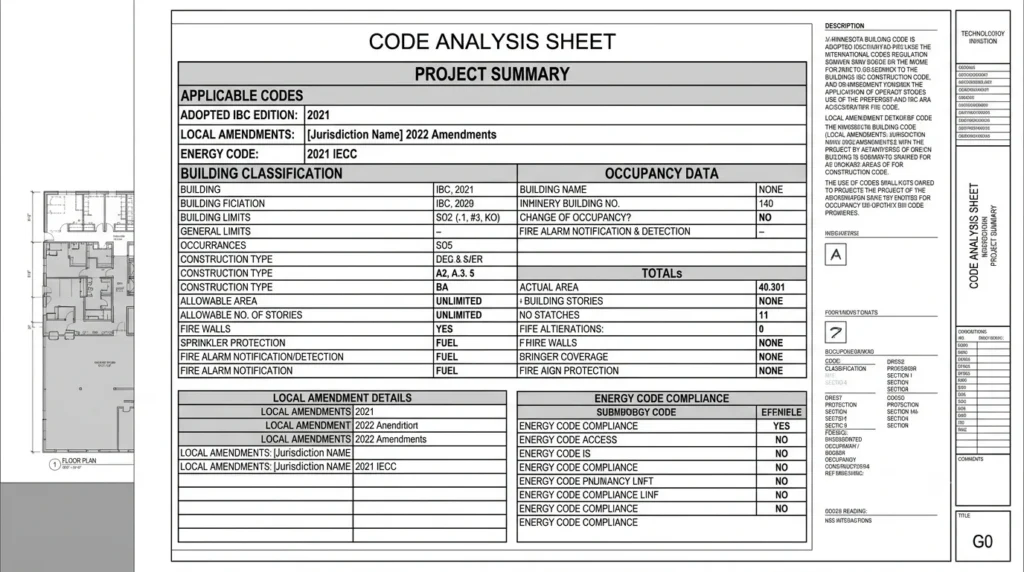
1. They confirm the adopted edition before drawing, through the ICC code adoption resources or directly with the authority having jurisdiction, and they record it on the code analysis sheet.
2. They maintain a jurisdiction log per project — adopted edition, amendment document, energy code, fire district requirements — rather than carrying assumptions from the last project.
3. They flag conflicts instead of resolving them silently. A city amendment that contradicts a fire district access requirement is an architect’s call, not a drafter’s.
4. They work natively in imperial units and US sheet conventions, so nothing is lost converting a 24×36 set from metric habits.
5. They know which sheets carry code exposure — life safety plans, egress diagrams, accessibility clearances, assembly ratings — and treat those with a different level of scrutiny than a furniture plan.
The mistake we see most often is a firm assuming code familiarity transfers across states because the drafter did good work on a Texas project. It does not. Treat every jurisdiction as its own regulatory environment. The remote professionals who work well long-term are the ones who ask which edition applies before they ask which template to use.
That habit is teachable, but it is much faster to hire for it. Roughly 85% of the professionals we place have already worked on US projects, which means the code question is a conversation about specifics rather than a training program.
The Roles You Can Staff Remotely and the Ones You Cannot
Most architectural production work is software-mediated and travels well. Anything that requires a license, a legal signature or physical presence does not.
Staff remotely without much friction:
– Architectural drafters and CAD technicians producing construction documents from redlines
– Revit and BIM modelers, including model setup, family creation and clash coordination
– Junior and mid-level designers working schematic and design development studies
– 3D visualization and rendering specialists
– Specification writers and code research support
– Project coordinators handling submittals, RFIs, permit tracking and consultant coordination
– Marketing and proposal support for RFP responses
Keep onshore and licensed:
– Architect of record duties, including stamping and sealing drawings
– Any activity requiring state licensure or reciprocity under an NCARB path
– Construction administration site observation and field reports
– Signed correspondence with an authority having jurisdiction where local licensure is required
– Final quality control sign-off on life safety and accessibility
To be precise about the term: the architect of record is the licensed professional who takes legal responsibility for a project’s design and its code compliance. That responsibility cannot be delegated to a remote team member, offshore or nearshore, employee or contractor. Remote architecture staffing expands who produces the work. It does not change who answers for it.
Firms sometimes try to get clever here — a remote licensed architect in a Latin American country still cannot seal a US drawing. Any partner who implies otherwise should end the conversation.
How Architecture Team Scaling Works Without Headcount Risk
Architecture team scaling through an architecture staffing model works because you can add and release capacity on project timelines instead of employment timelines. That is the entire value proposition, and it maps directly onto a market where the billings index has been below 50 for most of three years.
A practical way to run it:
1. Identify your production floor — the volume of drafting and modeling work you would have even in a slow quarter. Staff that with permanent local employees.
2. Identify the delta — the work that arrives with a specific project and leaves with it. Staff that remotely.
3. Start with one person, not four. One drafter through one full document set tells you more about fit than any interview loop.
4. Ramp on project milestones. Add the second seat at DD, the third at CD, and let contracts end when the set is out the door.
5. Keep a named backup. Ask your partner who covers if your drafter is out for two weeks.
Onboarding speed is what makes this work at all. Placing someone in 72 hours from a pre-vetted bench is a different capability than running a 45-day search, and it changes which projects you can say yes to. The trade-off is that you are accepting a partner’s vetting rather than doing it yourself — which is why the vetting standard is the thing to interrogate, not the price.
The financial mechanics are straightforward. Nearshore placements typically run around 50% of the cost of an equivalent US professional, with no benefits load, no additional software seats billed to your overhead in most arrangements, and no severance exposure. On a firm running personnel costs at 52% of net revenue, shifting even two production seats to a flexible model can move you back under the 48% line where margins recover.
Why Bilingual Architecture Designers Change the Communication Math
The reason nearshore architecture staffing works and distant offshore often does not comes down to how many review cycles you can complete in a single business day.
Bilingual architecture designers in Latin America work within a one-to-three hour offset from most US time zones. A redline marked up at 10am gets a question back at 10:20 and a revised sheet by 3pm. Same day, same set, no handoff note. Compare that to a 10 to 12 hour offset where every clarification burns a calendar day, and a three-round coordination issue takes a week that a same-zone team resolves before lunch.
Language fluency matters for a specific and underrated reason: architecture runs on ambiguous verbal shorthand. “Pull that back to the face of stud.” “This wall type should match the corridor.” “Can you check the head height at the stair.” Those sentences are not in any glossary. A designer who is genuinely fluent asks a clarifying question. A designer who is not guesses, and you find the guess in the set two weeks later.
Cultural overlap does real work too. Shared references around client expectations, meeting rhythms and what “urgent” means reduce the coordination overhead that makes distributed teams expensive. It is not a soft benefit — it shows up as fewer rework hours.
If you want to see what that looks like in practice, our team walks through real remote AEC workflows on the WorldTeams channel.
How to Vet Architecture Staffing Agencies
Most staffing agencies for architects will tell you they have vetted talent. Very few will tell you what the vetting actually filtered for. Ask these questions in this order:
1. What percentage of applicants do you place, and what eliminates the rest? A specific answer signals a real process. Ours is the top 3% of applicants.
2. How many of your professionals have worked on US projects, and in which states? You are testing for code and convention exposure, not just software skill.
3. Show me a full construction document set this candidate produced. Not a portfolio render. A set, with a code analysis sheet, dimension strings and sheet notes.
4. Which code editions has this person worked to? A drafter who answers “2021 IBC with Texas amendments, and 2019 CBC on two California projects” is a different candidate than one who says “US codes.”
5. Who covers if this person leaves or gets sick? Bench depth is the difference between a staffing partner and a matchmaking service.
6. What happens if the fit is wrong in week three? Look for a replacement guarantee or a money-back guarantee, in writing.
7. Do you specialize in AEC or place across every industry? Generalist recruiters cannot evaluate a Revit family or read a wall section.
Run a paid test engagement before a long commitment. One small scope — a permit set for a single-family remodel, a model cleanup, a set of interior elevations — reveals more than any reference call. Watch three things: how they ask questions, how they handle your first redline round, and whether they flag a code issue you missed.
Your First 30 Days With a Remote Drafter
The fastest useful thing you can do this week is write down your standards. Most firms have never documented them, which is why remote onboarding feels harder than it is.
Days 1 to 3: Share your template file, title block, layer or view standards, sheet naming convention and one recently completed set as a reference. Give access to your BIM environment and your project management tool on day one, not week two.
Days 4 to 10: Assign a bounded first scope with a real deadline — one sheet series, one model discipline. Review the first submission line by line and explain the reasoning, not just the correction. This is the highest-leverage hour you will spend all month.
Days 11 to 30: Expand scope, add them to the coordination call, and hand over ownership of a recurring task — the sheet index, the door schedule, the permit tracker. Ownership is what turns a resource into a team member.
The hesitation we hear most is that training a remote person costs more than the savings. It costs about the same as training a local hire, minus the two months of searching. And you only pay it once, if you keep them.
Building a Two-Tier Production Model Once One Seat Works
If you already have one or two remote seats running well, the next move is structural: split your production by liability exposure rather than by seniority.
Draw a line through your document set. On one side sit the sheets where an error creates code or life-safety exposure — life safety plans, egress and occupancy calculations, accessibility clearances, fire-rated assembly details, structural coordination. On the other side sit the sheets where an error creates rework but not risk — furniture plans, finish schedules, interior elevations, presentation graphics, model maintenance, sheet setup.
Assign the second category fully to your nearshore tier, with ownership and a named QA reviewer. Keep the first category authored or directly supervised by licensed staff, with the nearshore tier producing under redline rather than authoring.
Then add one gate: a formal code-check pass before every submittal, performed by a licensed reviewer against a written checklist tied to that jurisdiction’s adopted edition. Not a general set review. A code-specific pass, with the adopted edition and amendment document named at the top of the checklist.
Firms that implement this stop having the “can we trust remote work” conversation, because the question is now answered by structure instead of by trust. It also makes the model resilient — when a remote seat turns over, the replacement inherits a defined scope with defined boundaries.
The prerequisite is honest: do not attempt this until you have run at least one complete project through one remote seat and documented what broke. Building an architecture staffing structure on assumptions instead of evidence produces a very organized version of the wrong workflow.
Tools That Make Remote Architecture Production Work
Start with two: cloud-hosted BIM and a real markup tool. Everything else is optimization.
Production and coordination:
– Autodesk Construction Cloud / BIM Collaborate Pro — live model collaboration across locations. Best for any firm with more than two people in a Revit model. Paid, per seat.
– Bluebeam Revu — the markup standard for redline cycles and submittal review. Best for firms where PDF review drives the workflow. Paid.
– Newforma or Monograph — project information and time tracking that makes remote hours visible. Best for firms billing hourly against phases. Paid.
Code and compliance:
– ICC code adoption resources — confirm the adopted edition per jurisdiction before drawing. Free.
– UpCodes — searchable code text with jurisdiction-specific amendment layers. Best for firms working across multiple states. Freemium.
– The local building department’s amendment document — unglamorous, free, and the single most skipped resource in this entire list.
Communication:
– Slack or Teams with a dedicated project channel per job. Free tier is usually enough.
– Loom or any async video tool for explaining a redline once instead of typing it three times. Freemium.
In our own architecture staffing placements, the pattern that consistently predicts success is boring: cloud BIM plus Bluebeam plus one shared channel per project. Firms that try to run remote production over email attachments struggle regardless of how good the drafter is.
What Separates Firms That Scale Cleanly From Firms That Stall
– Architecture staffing adds people to your team; outsourcing returns deliverables. Pick based on whether the problem is capacity or scope.
– The market pressure is real: 41 months without majority billings growth, project inquiries at 56.1, personnel costs averaging 49% of net revenue. Flexible capacity is a margin decision, not a cost-cutting one.
– “Knows US code” means nothing. “Works to the jurisdiction’s adopted edition and its amendments” means everything, because a citation to a non-adopted section gets rejected at plan review.
– Licensure does not travel. Remote staffing changes who produces the work, never who stamps it.
– Time-zone overlap is the difference between three review cycles a day and one a day. That ratio is the real nearshore advantage.
– Start with one seat and one full document set. Structure comes after evidence, not before it.
– Interrogate the vetting standard and the bench depth, not the hourly rate.
Nearshore architecture staffing typically costs around 50% of an equivalent US professional. The savings come from regional labor market differences plus the elimination of benefits load, payroll taxes, additional office overhead and severance exposure. For context, BLS reported median US pay of $65,380 for drafters and $96,690 for architects in May 2024, before a 25% to 35% load for benefits and taxes.
Yes, provided they work to the code edition your jurisdiction has actually adopted and a licensed architect reviews and seals the set. The risk is not the drafter’s location — it is the assumption that the newest model code applies. More than half of US states have been operating on a building code based on the 2018 IBC or older, and states like California, New York and Florida use their own amended versions.
Nearshore is better when the work requires back-and-forth; offshore is competitive when the work is high-volume and fully specified in advance. For architecture staffing decisions, the deciding factor is review cycles. A one-to-three hour offset allows several redline rounds in a single business day, while a ten-to-twelve hour offset makes each clarification cost a full day.
With a pre-vetted bench, placement can happen in as little as 72 hours, with meaningful production inside two weeks. Compare that to 45 to 60 days to fill a local drafting position, longer in tight markets like California, New York and Texas. The gap in speed, not the gap in salary, is usually what changes which projects a firm can accept.
No, because they are not acting as the architect of record. Licensure is required to stamp and seal drawings and to take legal responsibility for code compliance, and that role stays with your licensed staff. Production work — drafting, modeling, rendering, coordination, specification research — does not require US licensure. No remote professional in another country can seal a US drawing, regardless of their credentials at home.
Anything requiring licensure, a legal signature or physical presence: architect of record duties, sealing drawings, construction administration site observation, and final sign-off on life safety and accessibility. Everything downstream of a licensed decision — construction documents, BIM modeling, visualization, permit tracking, specifications — is software-mediated and travels well.
Not yet, and the current AIA data suggests the effect is small in both directions. In the May 2026 ABI survey, 3% of firms reported reducing staff due to AI use while 2% reported adding staff because of it. Automation is compressing repetitive modeling and documentation tasks, which raises the value of drafters who handle code research, coordination and judgment rather than pure production.
Where This Leaves Your Next Deadline
Most firms do not have a talent problem. They have a timing problem.
The work arrives before the confidence to hire does. Then it leaves before the salary does.
Remote architecture staffing is just a way to line those two things up. One seat, one set, one honest look at what breaks.
If it helps, we have done this with 370+ firms across the US and Canada, including Toll Brothers, and we will place someone in 72 hours with a money-back guarantee if the fit is wrong. But start smaller than that. Start with one drafter and one document set, and see whether the review cycles get faster.
That is the only metric that matters in month one.
Internship pipelines also run on their own academic calendar, and construction management internship requirements explain why that creates predictable staffing gaps firms plan around.
If a prior offshore drafting arrangement is the reason you are reading this, why offshore drafting fails and what remote architecture staffing fixes walks through the specific pattern and what to check the next time around.