Why International Recruitment Agencies Are Key to Global Hiring Success
Share this article


Key takeaways
- International recruitment agencies can support sourcing, screening, cross-border coordination, and remote onboarding.
- Recruitment agencies, RPO providers, EORs, and outsourcing partners serve different roles; compare responsibilities before choosing a model.
- Architecture and engineering firms can use international hiring to reach specialized production talent beyond their local market.
- Employers still need clear communication, time-zone workflows, and country-specific legal or tax guidance.

International recruitment agencies help employers source and evaluate candidates across countries. Their exact role varies: some focus on recruiting, while others also coordinate onboarding, documentation, or ongoing remote-team support.
For architecture and engineering firms, the right partner can expand access to specialized production talent beyond the local market. This guide explains the benefits, risks, service models, and evaluation criteria to consider before working with international recruitment agencies, in high-skilled sectors such as architecture and engineering.
What Are International Recruitment Agencies?
International recruitment agencies are specialized firms that help companies hire qualified candidates from other countries. Depending on their service model, they can support sourcing, screening, local hiring coordination, cultural alignment, and remote onboarding. These agencies focus on cross-border recruitment, making them invaluable partners in today’s complex labor market.
Whether you’re hiring for a single role or scaling a full team, these agencies can simplify overseas recruitment and help assess technical and cultural fit.
International Recruitment Agency vs. RPO, EOR, and Outsourcing
These models can overlap, but they do not solve the same problem. Companies should compare the provider’s contractual role, who employs or engages the worker, and which party owns each compliance and management responsibility.
Swipe horizontally to compare all models.
| Model | Typical role | Best suited for |
|---|---|---|
| Recruitment agency | Sources and screens candidates for defined roles; the hiring or engagement structure is agreed separately. | Companies filling individual positions. |
| Recruitment process outsourcing (RPO) | Operates part or all of the recruiting workflow on an ongoing basis. | Organizations with recurring or multi-role hiring needs. |
| Employer of record (EOR) | Employs the worker through its local entity and administers payroll and statutory employment obligations under its service agreement. | Companies considering employee arrangements where they do not have a local entity. |
| Outsourcing or staffing partner | Provides remote professionals or managed capacity under the provider’s service model. | Teams that need flexible, integrated production support. |
WorldTeams also offers recruitment process outsourcing for organizations that need broader recruiting support. Exact responsibilities vary by provider, contract, and country, so confirm the operating model before selecting a partner.
The Rising Demand for Global Talent
As remote work and digital collaboration have expanded, organizations have more options to hire talent beyond their immediate geography. Successful distributed hiring still depends on clear communication, role expectations, and team workflows.
This shift has fueled the growth of international recruitment agencies, who are uniquely positioned to help companies leverage global recruitment services efficiently. Their regional knowledge can help employers coordinate local requirements, communication expectations, and onboarding when building a distributed team.
Advantages of Working with International Recruitment Agencies
1. Access to Global Talent Pools
One of the primary advantages is broader access to international networks of professionals. Whether a company needs specialized software engineers or skilled drafters, an experienced agency can help identify qualified candidates across multiple markets.
2. Streamlined Hiring Processes
From sourcing and vetting to onboarding, international recruitment agencies can support multiple stages of the global talent acquisition journey. This can reduce administrative work and give the employer a more consistent hiring process.
3. Cost Efficiency
Hiring across markets can give companies a wider range of compensation and engagement options. Employers should compare total costs, role requirements, and local obligations rather than evaluating salary alone.
4. Risk Mitigation
International employment requirements can be complex. Depending on the engagement model, agencies may coordinate documentation and local guidance, while employers should confirm legal, tax, and worker-classification obligations with qualified advisors.
5. Remote Hiring Expertise
Agencies experienced in remote hiring can help define repeatable workflows and support new hires as they join the existing team structure.
Use Case: International Hiring in the Architecture & Design Industry
Architecture firms often need specialized production support for design development, drafting, or visualization as project demand changes. International recruitment gives them another way to evaluate role-specific talent beyond their local market.
By partnering with an international recruitment agency, these firms can evaluate experienced professionals who are prepared to contribute remotely and compare different staffing models against local hiring.
Moreover, many firms now rely on architecture outsourcing services and architectural design support to add flexible production capacity alongside their internal teams.
Choosing the Right International Recruitment Partner
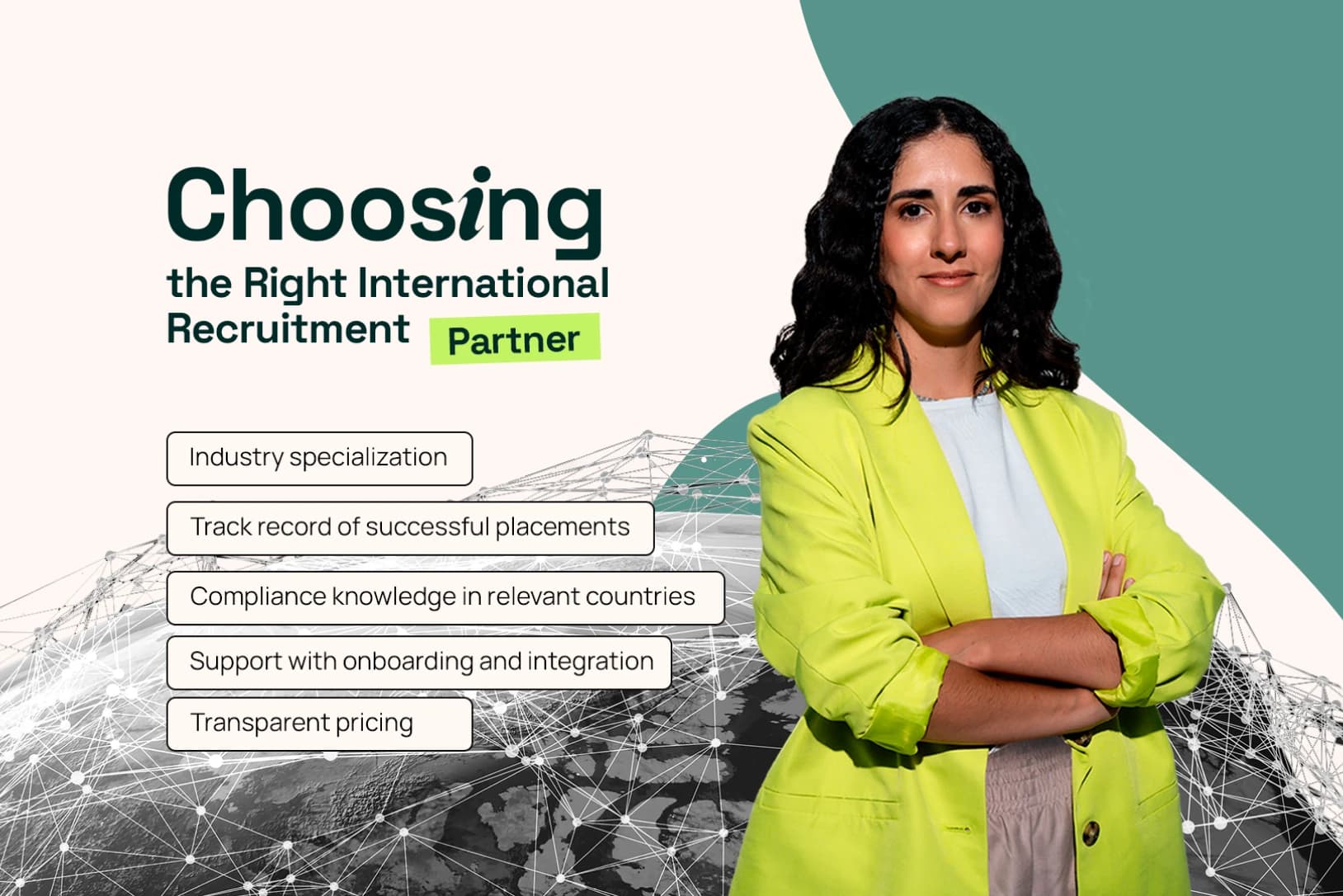
When selecting an agency, look for:
- Industry specialization, such as architecture, engineering, or IT
- A documented track record of successful placements
- Knowledge of the relevant countries and engagement models
- Support with onboarding and team integration
- Transparent pricing and clearly defined responsibilities
A strong recruitment partner should act as a strategic extension of your HR department — not just a vendor.
Learn how to cut labor costs while hiring the best talent in 2026
Download our FREE guide to learn how!
Common Challenges in Global Recruitment
While the benefits are clear, there are also challenges to plan for:
- Time-zone coordination: Distributed teams need clear overlap hours and communication protocols.
- Cultural differences: Work styles and communication expectations should be discussed during hiring and onboarding.
- Compliance requirements: Employers need country-specific guidance on contracts, taxes, and worker classification.
An experienced recruitment partner can coordinate these workstreams, but the employer remains responsible for confirming the requirements of its specific hiring arrangement.
Real Example: Scaling a Distributed Drafting Team
The Toll Brothers success story documents how the homebuilder expanded drafting capacity from 5 to 70 people through a remote staffing model built around standardized workflows and U.S.-aligned project management.
The case illustrates why partner selection involves more than candidate sourcing: training, quality control, workflow alignment, and the ability to scale with demand all influence the result.
Related Use Case: Hiring Architectural CGI Specialists
Architectural CGI is one example of a specialized role that firms can source internationally. Potential advantages include:
- Specialized experience: Evaluate candidates who understand lighting, materials, and architectural design principles.
- Flexible capacity: Add rendering support when project demand exceeds the internal team’s availability.
- Defined deliverables: Scope output formats, review cycles, software, and deadlines before work begins.
The same partner-evaluation criteria apply: firms should confirm technical fit, communication expectations, pricing, and intellectual-property requirements before engaging a CGI companies or individual specialist.

Why WorldTeams Is the Right Partner for Your Global Talent Needs
At WorldTeams, we connect architecture and engineering firms with remote professionals across Latin America. Whether you’re looking for support in architectural drafting services, design development, or visualization, our recruitment and outsourcing model is designed to support role matching and remote team integration.
By focusing on both technical requirements and team fit, we help firms compare candidates against the way they work. From Outsourcing architectural services to architectural design support, our recruiting network helps firms evaluate professionals against their technical and collaboration requirements.
Need international talent for your next project? Let’s talk.
Sources and Further Guidance
Employment and worker-classification requirements depend on the facts, the engagement model, and the countries involved. These primary sources provide additional guidance:
- Internal Revenue Service: Independent contractor defined — U.S. federal tax classification guidance.
- U.S. Department of Labor: Fact Sheet 13 — U.S. federal labor guidance on employee and contractor status.
- International Labour Organization: The employment relationship — international context and relevant labor standards.
This article is general information, not legal or tax advice. Employers should obtain qualified guidance for each hiring arrangement.
Frequently asked questions
Quick answers to the most common questions about choosing and working with an international recruitment partner.
What does an international recruitment agency do?
An international recruitment agency sources, screens, and helps onboard qualified candidates across countries. Companies can review the WorldTeams hiring process to see how role discovery, candidate review, and onboarding support fit together.
How can international recruitment agencies reduce hiring risk?
Experienced agencies help employers verify candidates and coordinate documentation or local guidance. Employers should still confirm worker-classification, tax, and employment obligations for the specific countries and engagement model involved.
What should a company evaluate before choosing a recruitment partner?
Companies should review the agency’s industry specialization, placement track record, compliance knowledge, onboarding support, and pricing transparency. This guide to finding remote architects shows how those criteria apply when technical skills and collaboration both matter.
Why is international recruitment useful for architecture and engineering firms?
Architecture firms can explore architecture outsourcing services, while engineering firms can review engineering outsourcing services. Both models can expand access to specialized remote professionals as project demand changes.
What are the main challenges of international recruitment?
Common challenges include time-zone coordination, differences in communication and work styles, and country-specific employment requirements. Our article about building trust and collaboration in remote teams covers the communication side in more detail. Each jurisdiction sets its own employment requirements, so those get checked per country and per engagement model.
How do international recruitment agencies support remote onboarding?
They can coordinate candidate documentation, clarify role expectations, and establish communication and integration steps before the new hire starts. The remote architect onboarding guide explains how teams can turn those steps into a repeatable onboarding workflow.