Why a Firm Can’t be Only Built Based on Talent with Sophia Zhang
Share this article


“The Hidden Rules of Architecture“. An interview by Camila Brugger, Founder & CEO of WorldTeams, with Sophia Zhang, Founder of SOZA Architecture.
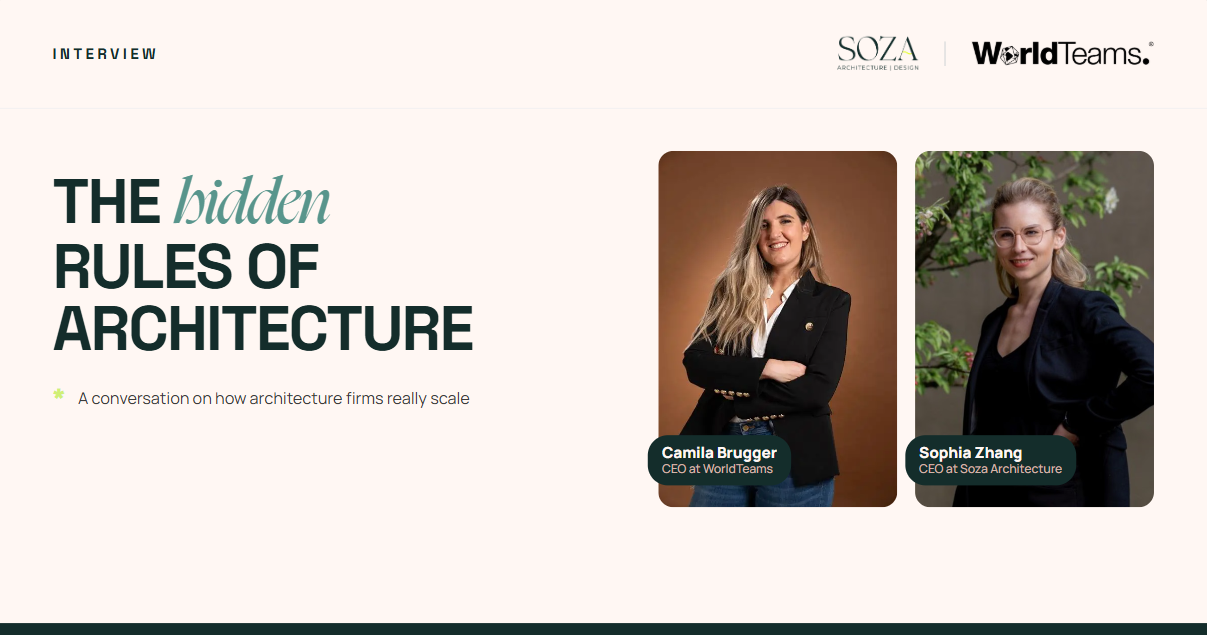
Architecture school teaches you to obsess over the object — the laser-cut model, the perfect wall section, the crit-ready concept. What it doesn’t teach you is how to get someone to pay for any of it. In a candid conversation with WorldTeams’ founder Camila Brugger, Sophia Zhang — Harvard-trained architect and founder of Boston’s SOZA Architecture — named the disconnect directly:
“Biggest lie I have ever been told: that your talent alone is going to make you a success.”
What follows is the rest of the honest list — the hidden rules of running an architecture firm that Zhang has learned in three years of building SOZA from scratch, while raising two kids, rebranding three times, and figuring out AI, outsourcing, and the business of design in real time.
The Hidden Rules, According to Sophia Zhang
- Talent is not a strategy. “Your drawings should speak for themselves” is the industry’s most expensive myth.
- You can’t prepare in someone else’s firm. “No amount of working for somebody else is going to prepare you for a business”.
- Delegate, delegate, delegate. Constraints (motherhood, time, cash) force clarity on what only you can do.
- AI is a tool, not a replacement. Zhang rates AI’s disruption of the profession a 5/5 — but not because it replaces architects.
- Selling is not a dirty word. “You are sitting in front of a real person who you’re trying to convince to buy what you’re selling.”
- Beauty is the point. Her closer: “It is the entire purpose of what we do”
Who is Sophia Zhang?
Sophia Zhang is the founder of SOZA Architecture, a woman-owned (WBE) design studio based in Boston. She’s a Harvard Graduate School of Design alumna who spent six years at an established Boston firm before starting her own practice in 2022. She’s also a mother of two, a self-described “influencer” for her profession, and — by her own admission — someone who has rebranded her firm three times in as many years as she figures out who she is as a business owner.
What do we mean by the “hidden rules of architecture”?
The “hidden rules of architecture” are the unwritten business skills — sales, branding, delegation, networking, pricing, and client psychology — that determine whether a design practice could survive or not. They’re the things architecture school treats as taboo but that decide, in Zhang’s words, whether “someone pays you for the things you’re going to help you do.”
Insights on leaving a Harvard-pedigree job to start SOZA
Zhang explained that family planning forced the timing, but the deeper realization was that you can’t wait to feel ready. She had her first child and knew returning to a 12-hour-day firm wasn’t sustainable — a story she calls “pretty common” for women in architecture. Then came the harder truth:
“No amount of working for somebody else is going to prepare you for a business. You’re going to have to jump into it one way or another.
Her first project was a basement renovation in Southie, taken on jointly with another architect. Her only real strategy, she says, was to drop the fear of judgment and ask for help — from mentors, from other founders who had done it, from anyone who would talk to her. “You’ll be surprised at how much people want to help you.”
How does a founder-architect actually get anything done?
By treating constraints as a feature, not a bug. Zhang’s day runs 8 to 5, with hard stops for school runs and family. Weekends are off-limits. The compression, she argues, is what makes her sharper: it sharpens the perspective and clarifies priorities.
Delegation is where most solo founders get stuck. Not because they don’t want to hand things off, but because they can’t afford local hires and don’t trust the alternatives.
What about outsourcing — the fear every solo architect has?
Zhang was in exactly that position when WorldTeams reached out. Her honest reflection on the moment:
“You go and Google outsourcing companies and like 5,000 come up. So how do you even make that decision?… You reached out to me with a very specific email saying, ‘Hey, look, we see what you’re doing’… I reached out simply because I saw that you put in the time, that you cared enough… The most important thing is that I felt understood and seen.”
Three-plus years in, Zhang’s team at SOZA is genuinely global. She has WorldTeams collaborators drafting and modeling for her right now, alongside local consultants.
Asked what she’d tell an architect on the fence, her answer was blunt: “Talk to your team. Do some research. Take a leap — because a lot of what we don’t realize takes up our time is the thing that we need to offload.”
Her only real prior fear? Distance. Not culture — she grew up between Kazakhstan and Toronto and finds cross-cultural collaboration “more interesting and fun.” Just proximity. And that fear, she says, dissolved fast.
The Big Question: Will AI replace architects?
Zhang rates AI’s disruption of architecture in the next three years at a 5 out of 5 — but with a critical caveat.
“I don’t mean that by it will replace architects, not at all… Unequivocally, it’s a tool.
She uses AI daily — Claude in particular — as a research assistant, a calculator, a copywriter, a naming tool for decision-fatigue moments, and a benchmark for fees when no one else in the industry will talk numbers. What she doesn’t do is let it own the client relationship:
“When I do a walk-through with a husband and wife in their house, and the wife is lingering in the kitchen, but the husband rushes by like past the kitchen — that’s information. That’s not something that Claude is going to be able to do.
A takeaway for firm leaders? AI won’t replace architects because liability, site problems, intuition, and lived context can’t be automated. But firms that don’t build AI into their workflow — starting with process mapping the painful, repeatable pieces — will be outrun by firms that do.
The one thing she thinks it can’t be learned in college about running a firm
Selling. And by extension, branding, positioning, and the fact that clients don’t hire your portfolio — they hire the conversation before it. She argues the perspective that settles selling on branding’s opposite site, just because “your drawings should speak for themselves”.
She’s equally hard on the starchitect fantasy: every success story, she argues, involves a network, family money, or luck — not just talent. And in a market flooded with capable architects, positioning is the whole game.
“You have to convince people that you’re good, and your work is at the end of the line. What happens before, in those early conversations, is how you convince somebody that you are worth spending time with.”
What’s her honest advice to architects starting their own firm?
Just don’t recreate the firm you left, building the same practice at smaller scale. Zhang advises to take the “time for you to discover yourself, what’s meaningful to you”. And network. Openly.
How much does beauty matter?
Camila’s closing question was Zhang’s favorite: the one she wishes clients would ask.
“Architects are so focused on talking about sustainability and innovation and technology, and we sell ourselves that way, and that’s why every single website you go to reads and looks exactly the same. But we don’t ever talk about beauty… I wish that clients would ask me what I think beauty is. Because that is not a secondary goal. And it is not a soft goal. It is the entire purpose, the entire purpose of what we do.
She calls her philosophyuninhibited elegance — vulnerability, openness, and the willingness to say what you actually think is beautiful, out loud, in a room where the safe answer is a spec sheet.
What all this means for architecture firm leaders
- Stop waiting to feel ready. The prep never comes; the doing is the prep.
- Treat selling as core practice. Not a side task. Not a taboo. The main event.
- Delegate on purpose. Local hires, consultants, (or better) nearshore teams! Whatever gets production off your plate so you can design and sell.
- Use AI where it saves minutes, not where it costs relationships. Map the painful processes; automate those. Guard the client conversation.
- Rebrand when you outgrow yourself. Three times, if that’s what it takes.
- Say what you find beautiful. That’s the differentiator no algorithm can copy.
Where WorldTeams fits in
The bottleneck Zhang describes — a solo founder buried in production, unable to hire locally, terrified of picking wrong from 5,000 outsourcing companies — is the problem WorldTeams was built to solve.
WorldTeams connects U.S. architecture firms with pre-vetted, time-zone-aligned nearshore professionals— drafters, BIM specialists, renderers, junior architects — supported by a dedicated Account Manager who handles the fit, the onboarding, and the ongoing relationship. On the other hand, firms typically save up to 50% versus U.S. hires while keeping real-time collaboration intact.
If you’re a firm principal, explore architecture outsourcing services. If you’re an architect looking to work with U.S. clients, go see our openings at WorldTeams.
▶ Watch the full interview: The Hidden Rules of Architecture ft. Sophia Zhang, CEO at SOZA Architecture, hosted by Camila Brugger — the full conversation on family, firm-building, AI, and beauty.
About our host
Camila Brugger is theFounder and CEO of WorldTeams, a talent company connecting U.S. firms with skilled remote professionals, specialized in architecture, engineering, and the broader built environment. She hosts candid conversations with firm leaders about the real mechanics of building a design business — the ones nobody teaches you.